




How to Choose Desks and Chairs for Primary and Secondary School Students
Choosing suitable desks and chairs for primary and secondary school students is extremely important for their physical development, learning efficiency, and long-term health. Children spend many hours every day sitting while studying, doing homework, or reading. If the desk and chair are not properly designed, it may lead to poor posture, fatigue, or even long-term problems such as back pain, spinal curvature, and vision issues. Therefore, parents and schools should carefully consider several factors when selecting student desks and chairs.
First, ergonomic design is one of the most important factors. A good student desk and chair should support proper posture. When a child sits correctly, their feet should rest flat on the floor, their knees should form approximately a 90-degree angle, and their back should be supported by the backrest. The desk height should allow the student’s forearms to rest comfortably on the tabletop while keeping their shoulders relaxed. Proper ergonomics help reduce pressure on the spine and neck, allowing students to study for longer periods without discomfort.
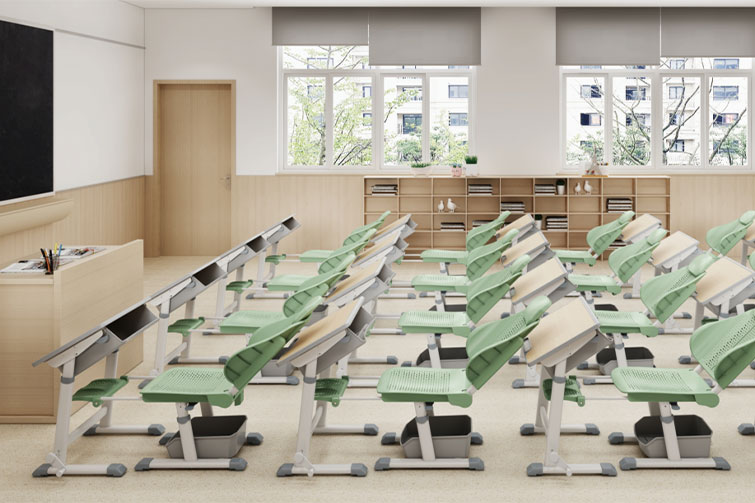
Second, adjustable height is highly recommended, especially for growing children. Students in primary and secondary school experience rapid physical growth, and furniture that cannot be adjusted may quickly become unsuitable. Height-adjustable desks and chairs allow the furniture to grow with the child. Many modern student desks include adjustable legs and chairs with adjustable seat heights and backrests. This flexibility ensures that students maintain correct posture at different stages of growth.
Third, appropriate desk size and workspace should also be considered. The desktop should be large enough to accommodate textbooks, notebooks, and a computer or tablet if needed. At the same time, the desk should not be too large for the child’s reach. A practical desk design often includes storage features such as drawers, shelves, or book holders, which help students organize their study materials. A tidy study environment can improve concentration and learning efficiency.
Another important factor is material quality and safety. Student desks and chairs should be made from durable, non-toxic, and environmentally friendly materials. Common materials include solid wood, engineered wood, metal frames, and high-quality plastics. The surfaces should be smooth and free from sharp edges to prevent injuries. Additionally, stable structures and anti-slip feet are important to ensure safety during daily use.
Comfort and durability are also key considerations. The chair seat should provide enough support and comfort for long periods of sitting. Some chairs use breathable materials or slightly curved seat designs to improve comfort. Strong structural design and high-quality hardware ensure that the furniture remains stable and durable even with frequent daily use.
Finally, proper lighting and study environment should be considered when choosing a desk. The desk surface should allow enough space for a desk lamp, and the height should be suitable for reading and writing under proper lighting conditions. A well-designed study setup helps reduce eye strain and encourages better study habits.
In conclusion, selecting the right desks and chairs for primary and secondary school students involves careful attention to ergonomics, adjustability, size, materials, safety, and comfort. Properly designed student furniture not only supports healthy physical development but also creates a more comfortable and efficient learning environment. By investing in suitable desks and chairs, parents and schools can help students develop good posture and study habits that will benefit them for many years.
Related Posts